
Replacing manual timesheets with a system built to scale
How Cursor built a bespoke timesheet and expenses web app to support Infinity Engineering's growth ambitions
How Cursor built a bespoke timesheet and expenses web app to support Infinity Engineering's growth ambitions

Infinity Engineering is a Lincoln-based specialist in rotating equipment, serving the power generation and oil & gas sectors. Its engineers work on client sites all over the world, from onshore facilities to offshore installations, keeping critical equipment running for operators in the energy industry.
With a current staff count of 20 and a growth trajectory towards more than 200 employees, the company needed a way of managing time and expenses that could scale.
Infinity’s engineers log hours spent working across onshore and offshore shifts, and travelling to and from sites. These are categorised against different charge codes, which are often billed at different rates. Timesheets are signed off by both an internal line manager and the client before being passed on for invoicing.
Engineers had to write down their hours worked on spreadsheets. These then had to be manually approved by a manager and signed off by the client before they could even be submitted for invoicing, all on a monthly cycle. That meant slower billing, more admin, and formats that weren't easy for clients to review. Infinity Engineering also wanted to bring expense claims, including receipts and supporting evidence, into the same process.
The team looked at commercial off-the-shelf options such as Chime, but found they came loaded with features Infinity Engineering didn't need, like GPS tracking, and priced per user in a way that wouldn't scale affordably to 200+ engineers.
Infinity Engineering approached Cursor to build something purpose-built instead.
Cursor designed and built a bespoke, Infinity Engineering-branded, mobile-first timesheet and expenses web application.
Engineers can log in from any device, wherever they're working, and record time against the correct job and charge code, whether that's a dayshift or nightshift, onshore or offshore, or time spent travelling. A shift that starts one day and finishes the next is handled as a normal part of logging time, not an edge case. Each timesheet is reviewed and edited by the engineer before submission, with a named client signatory attached so the right person is notified for approval.

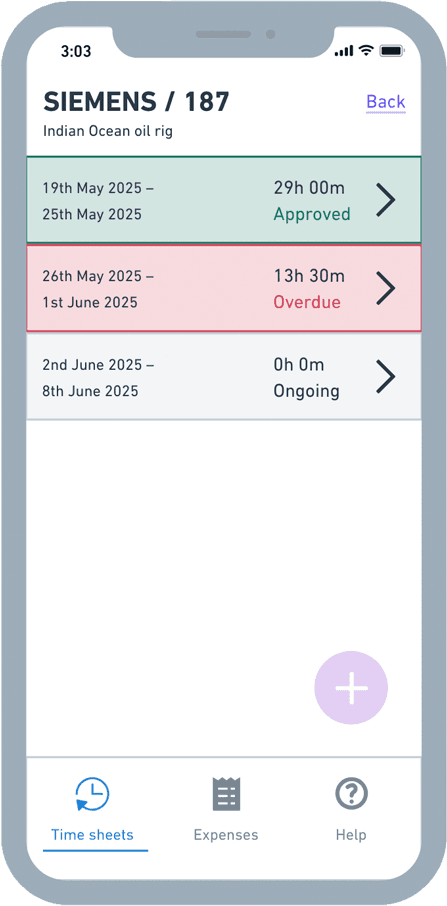


Once submitted, a line manager reviews the timesheet, and can approve it, or reject it with feedback for the engineer to correct and resubmit. Approved timesheets are then sent on for client sign-off via a secure email link which ensures confidentiality without requiring the client to have their own account on the system.
A simple visual tracker shows every timesheet's progress through the stages, from submission, to review by the named line manager, to sign-off by the named client contact, so anyone checking in on a timesheet can see exactly where it's up to and who's responsible for it. Every approval, at every stage, triggers automatic notifications, so nobody needs to chase.
The same approach applies to expenses. Engineers submit expense claims against a job with a photo of supporting evidence. Staff were also issued with company Revolut cards, and they can import payments from Revolut into the timesheets system before adding photo evidence. These claims follow their own line manager approval workflow, separate from but sitting alongside timesheets.

A self-service help centre
To help engineers get to grips with the system, particularly while working remotely on site, the app includes its own built-in help centre. Step-by-step guides walk engineers through creating a timesheet, adding a time record and submitting it for approval, alongside similar guidance covering the expenses process.
A dedicated FAQ section answers the practical questions engineers are most likely to have, from logging time across different time zones to what counts as proof of an expense, reducing the number of queries landing on the admin team.
From manual to online
Moving to a digital system also allowed Infinity Engineering to move from monthly to weekly timesheets, giving the business a faster, more frequent view of billable work and getting invoices out to clients quickly, no matter where in the world their engineers are.
Built for the admin team, not just engineers
Behind the scenes, a control panel gives Infinity Engineering full oversight and control. Admins can manage engineers and clients, set charge rates for both working and travel time on a job-by-job basis, and track every timesheet's status from submission through to invoicing.
Reporting was a key requirement. Admins can export timesheet data, expenses data, and invoice-ready data as CSV files, the latter formatted specifically to import straight into Xero, so an invoice covering both time and expenses can be generated with minimal manual handling.

One of the central challenges was designing a workflow that worked for three very different users: engineers working remotely on client sites, internal line managers reviewing submissions, and external clients who needed to approve timesheets without being given access to a whole new system. Keeping the client's part of the process to little more than an email and a digital signature was central to making the system easy to adopt.
Scalability also shaped every decision. With Infinity Engineering planning to grow from 20 to over 200 engineers, the system needed to handle that growth from day one, without the per-user cost penalties of the commercial platforms the company had already ruled out.
Infinity Engineering now has a bespoke timesheet and expenses system built specifically around how its engineers, managers and clients actually work, replacing a spreadsheet process that couldn't have scaled to match the company’s plans for growth.
Timesheets move through the business on a weekly cycle instead of monthly, expenses can be easily added or imported from Revolut, and generating invoices in Xero is now much easier thanks to new reporting features.
By building on proven, open technologies rather than an off-the-shelf platform, Cursor gave Infinity Engineering a system it fully owns, with the flexibility to grow as new features are needed.
